
Flavored vodka is vodka with a predominant flavor other than that of its raw materials. It falls under Category 31 of Regulation (EU) 2019/787: at least 37.5% vol., no more than 100 g of sweeteners per liter, and the designation “flavored vodka” or the word “vodka” followed by the name of the flavor, such as pineapple vodka.
Key Takeaways
- Flavored vodka is a legally recognized category in the European Union: vodka with a predominant added flavor, having an alcohol content of at least 37.5% by volume and containing no more than 100 g of sweeteners per liter.
- Its flavors are derived through four methods, either individually or in combination: maceration or infusion, redistillation, the addition of flavorings, and the addition of juice.
- The label "natural raspberry flavor" means that at least 95% by weight of the flavoring component comes from raspberries.
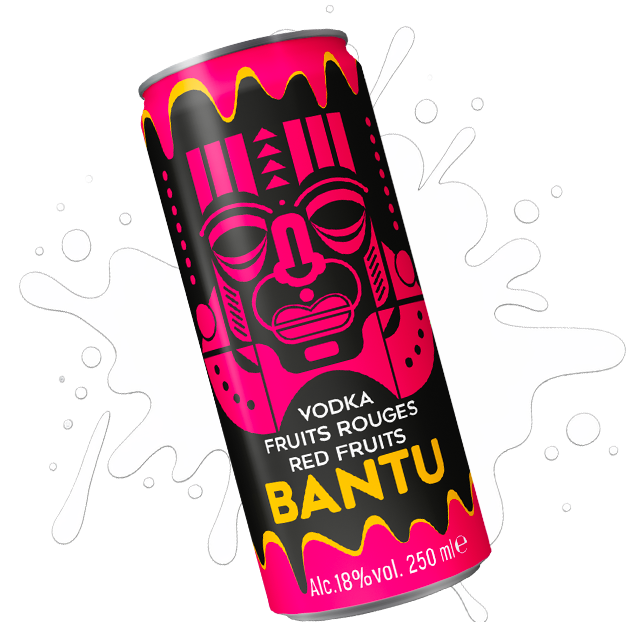
- Vodka premixes, such as Bantu products (Bantu Drinks), at 18% ABV, are not considered flavored vodkas under the law: that category begins at 37.5% ABV.
What is flavored vodka?
Regulation (EU) 2019/787 defines flavored vodka in Category 31 of its Annex I as vodka with a predominant flavor other than that of the raw materials used to produce it. The base must therefore be vodka, the spirit beverage in Category 15; the article “What Is Vodka Made Of?” describes its production.
The product may be sweetened, blended, flavored, aged, or colored. Its legal designation may be “flavored vodka” or the name of any predominant flavor combined with the word “vodka”: peach vodka, raspberry vodka, blackcurrant vodka, and red berry vodka are therefore fully legal designations.
The distinction from plain vodka lies in the word “predominant.” Vodka may only be flavored with natural flavoring substances or flavoring preparations present in the distillate of its fermented raw materials, without acquiring a predominant flavor. As soon as an added flavor dominates, the product is no longer vodka; at 37.5% vol. or higher and within the sugar limit specified below, it falls under category 31.
Flavored vodka, vodka-based liqueur, premix: What are the differences?
Flavored vodka, vodka-based liqueurs, and premixes differ in terms of their alcohol content, sugar content, and legal status. The regulations do not include a category for premixes.
| Product | Minimum Title | Sweeteners (invert sugar) | Legal Name |
|---|---|---|---|
| Vodka (Category 15) | 37.5% vol | No more than 8 g/l | "Vodka" |
| Flavored vodka (category 31) | 37.5% vol | No more than 100 g/l | "Flavored vodka" or "vodka" followed by the name of the flavor |
| Liqueur (Category 33) | 15% by volume | At least 100 g/l in most cases | "Liqueur," or a compound term such as "vodka liqueur" |
| Blackcurrant Liqueur (Category 34) | 15% by volume | More than 400 g/l | "Blackcurrant Liqueur" |
| Vodka Premix | No specific category | No category rule | Depends on the strength and composition; a premix that meets the requirements of Category 33 is a liqueur |
A liqueur is a sweetened and flavored spirit. The distinction from flavored vodka is based on a threshold of 100 g per liter: a flavored vodka cannot exceed this threshold, while most liqueurs must meet it. The term “vodka-based liqueur” is permitted only if all of the alcohol comes from vodka, with the exception of the alcohol contributed by flavorings, colorings, or other permitted ingredients.
A premix is a blend of a spirit and non-alcoholic ingredients, such as juice or tea, produced in a factory; the article “What Is a Premix? ” provides a complete definition. According to Article 11 of the regulation, the word “vodka” may appear in a compound term on a beverage label only if all of the alcohol in the beverage comes from vodka, and the vodka’s alcohol content has not been reduced to below 37.5% vol solely by the addition of water.
How is flavored vodka made?
Flavored vodka is produced by adding fruits, roots, leaves, flavorings, or juice to vodka through maceration, redistillation, or simple addition. Article 4 of the regulation defines flavoring as the incorporation of flavorings or flavor-imparting ingredients through addition, infusion, maceration, alcoholic fermentation, or distillation of the alcohol in their presence.
- Maceration or infusion. Fruits, zest, roots, or leaves are soaked in alcohol and then removed by pressing or filtration. The liquid extracts aromatic compounds as well as non-volatile compounds such as sugars, acids, and pigments.
- Redistillation. The macerate is distilled a second time: the volatile aromatic compounds, such as esters and terpenes, pass into the distillate, while the non-volatile sugars and pigments remain in the still.
- Flavorings. Flavoring preparations or flavoring substances, as defined in Regulation (EC) No. 1334/2008, are added to vodka.
- Juices and concentrates. A juice used primarily to flavor a spirit is a flavoring agent. It contributes sugars, acids, and color in addition to flavor, and it lowers the alcohol content, which must remain at least 37.5% vol.
The term “infused vodka” does not refer to a separate category: infusion is merely one of several production methods. An infused vodka in which the added flavor dominates falls under Category 31, subject to the same alcohol content and sugar content requirements.
Natural flavor, flavor, juice: what does the label say?
On a label, the term “natural raspberry flavoring” requires that at least 95% of the flavoring component come from raspberries, whereas “flavoring” alone refers to any flavoring, whether natural or not. However, beverages with an alcohol content of more than 1.2% by volume are not required to list ingredients: such information appears only if the producer chooses to provide it. The meaning of these terms is defined by Article 16 of Regulation (EC) No. 1334/2008.
| Label Statement | What it means |
|---|---|
| Flavor | Any flavoring, whether natural or not |
| Natural raspberry flavoring | At least 95% by weight of the flavor component derived from raspberries |
| Natural raspberry flavor with other natural flavors | A component derived from raspberries, with a taste that is easily recognizable |
| Natural flavoring | Made from several natural ingredients, the names of which do not accurately reflect their taste |
| Raspberry juice | A food ingredient, not a flavoring |
A natural food flavor is therefore not a juice. A natural flavoring substance is obtained through physical, enzymatic, or microbiological processes from materials of plant, animal, or microbiological origin.
Raspberry ketone, the primary aromatic compound in red raspberries, illustrates what this definition excludes. Extraction yields only about 1 to 4 mg per kilogram of raspberries, so commercially available raspberry ketone is produced industrially from chemical intermediates. This synthetic version cannot be included in a flavoring labeled as “natural.”
Sugar and Color: What Can Be in Flavored Vodka?
A sweetened flavored vodka may contain no more than 100 g of sweeteners per liter and may be colored, whereas regular vodka is limited to 8 g per liter and may not be colored. Both limits apply to all sweeteners listed in Article 4—from sugar to honey to glucose syrup—expressed as invert sugar.
The label is not required to list the sugar content: if the alcohol content is above 1.2% vol, a nutrition fact panel is not required. The permitted colorants are those listed in Regulation (EC) No. 1333/2008, and the fruit used to flavor the vodka also contributes its own pigments. Anthocyanins, water-soluble pigments found in raspberries and blackcurrants, appear red, pink, purple, blue, or black depending on the pH.
Flavors and aromas: notes of fruit, ginger, and tea
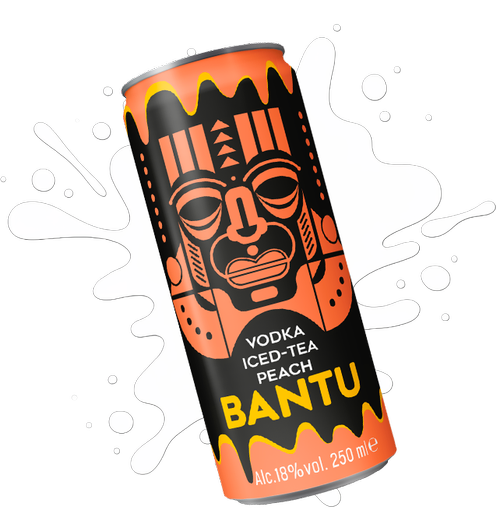
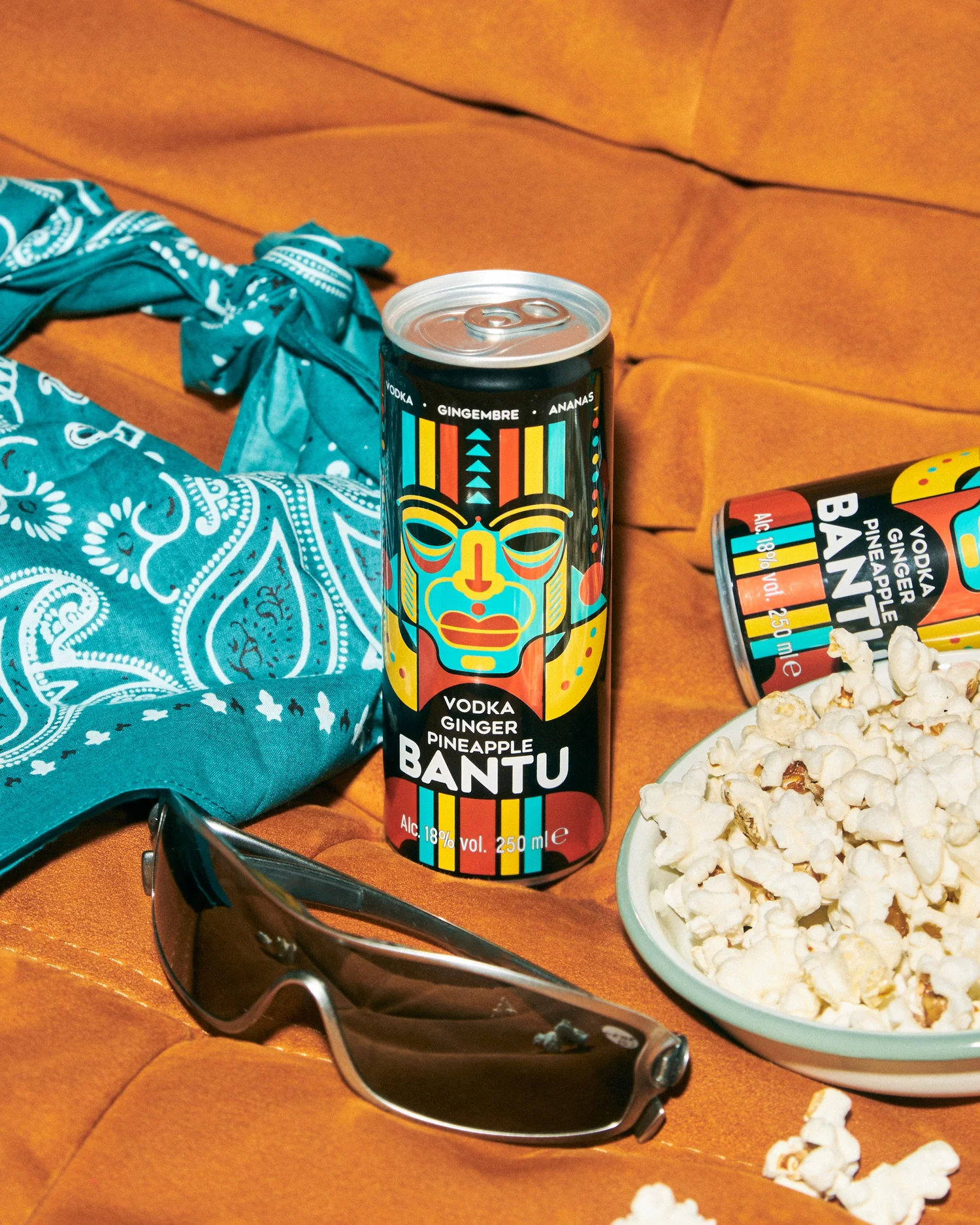
The flavor of a flavored vodka comes from the aromatic compounds in its raw materials: pineapple esters, peach lactones, and raspberry ketone. The seven raw materials listed below correspond to the declared flavors of Bantu products (Bantu Drinks), which are premixes and not flavored vodkas. Each profile describes the reference raw material, not a finished beverage.
Pineapple vodka: esters and furanol
Ethyl butanoate has a fruity odor similar to that of pineapple and is used in pineapple flavorings. Methyl butanoate, whose odor is reminiscent of apples or pineapples, is present in pineapple oil. Furanol, which is partly responsible for the scent of fresh pineapple, smells like caramel at high concentrations and resembles the scent of strawberries when diluted.
Ginger Vodka: Gingerols and Zingiberenes
Ginger's aroma comes from volatile oils, which account for 1 to 3% of the weight of fresh ginger and consist mainly of sesquiterpenes; zingiberene can make up as much as 30% of the essential oil. Its pungency comes from gingerols, the main one being [6]-gingerol; these activate the heat-sensitive receptors on the tongue. Drying or gentle heating transforms them into shogaols, which are about twice as pungent.
Peach Vodka: Lactones
The aroma of a ripe peach involves 110 volatile molecules. Among the lactones—cyclic esters that contribute to the flavor of many fruits—γ-decalactone has a characteristic peach flavor, and δ-decalactone has a creamy flavor reminiscent of coconut and peach. Malic acid is the primary acid in peaches.
Iced tea: black tea, theaflavins, and terpenic alcohols
Iced tea is commonly made from black, green, or oolong tea; this profile focuses on black tea. Black tea is more oxidized than oolong, yellow, white, and green teas, all of which are made from the leaves of Camellia sinensis. During this oxidation process, theaflavins and reddish thearubigins form in the leaf.
Polyphenols, which account for 30 to 40 percent of the leaf’s composition, give tea its astringency. The floral notes come in part from terpenic alcohols: linalool, which has a scent similar to that of lavender and is present in Darjeeling tea, and geraniol, which has a rose-like scent and is more abundant in Keemun than in other black teas.
Apple: esters, green aldehydes, and malic acid
Among the volatile compounds responsible for the smell of apples are esters, such as ethyl butanoate and ethyl 2-methylbutanoate, and two aldehydes. Hexanal has the scent of freshly cut grass; (E)-2-hexenal has the scent of crushed leaves with a hint of green apple. Malic acid contributes to the apple’s acidity.
Raspberry Vodka: Raspberry Ketone
Raspberry ketone, a phenolic compound, is the primary aromatic compound in red raspberries. Raspberries are also rich in anthocyanins, which are odorless and moderately astringent pigments.
Blackcurrant Vodka: Terpenes and Anthocyanins
Blackcurrant juice contains terpenoids such as α-pinene, δ-3-carene, limonene, and β-caryophyllene; esters such as methyl and ethyl butanoates; and eucalyptol, which has a camphor-like odor. The berries are a very dark purple, almost black; their main anthocyanins—delphinidin and cyanidin glycosides—are preserved in the concentrated juice. When fresh, the berry has a strong, tart flavor.
Pineapple, peach, or berry-flavored vodka: Where do the flavors in a premix come from?
In a vodka premix, the flavors of pineapple, peach, or red berries come from ingredients blended with the spirit at the factory, such as juice, tea, or flavorings. The mixture has an alcohol content of less than 37.5% vol and is therefore not considered a flavored vodka, even when it combines several fruits.
The three associations listed below are the declared flavors of the Bantu product line (Bantu Drinks). The analysis focuses on the reference raw materials, not on the ingredients or the taste of the finished beverages.
- Pineapple and ginger. Esters and furanol contribute to the scent of pineapple. Ginger contains zingiberene, an aromatic compound, and gingerols, which give it its spiciness.
- Peach and iced tea. Lactones contribute to the peach aroma. In black tea, polyphenols provide the astringency, and terpenic alcohols contribute some of the floral notes.
- Apple, raspberry, and blackcurrant. Malic acid contributes to the apple's acidity, and green aldehydes contribute to part of its aroma. The raspberry owes its primary aroma to raspberry ketone; the blackcurrant owes part of its aroma to its terpenes and its color to its anthocyanins.
Flavored vodka and geographical indications
Three European Union geographical indications (GIs) cover flavored vodka: two from Poland and one from Lithuania. Article 37 of Regulation (EU) 2019/787 automatically incorporated them, and they have been listed in the Union register provided for by Regulation (EU) 2024/1143 since May 13, 2024.
| Geographic Indication | Country |
|---|---|
| Herbal vodka from the Northern Podlasie Lowlands, flavored with bison grass extract | Poland |
| Polska Wódka / Polish Vodka | Poland |
| Original Lithuanian Vodka | Lithuania |
"Polska Wódka" and "Originali lietuviška degtinė" are also registered as vodkas. For these two GIs, Annex III of Regulation (EC) No. 110/2008, which registered them, required that a flavored product bear the sales designation “flavored vodka,” with the word “flavored” being replaceable by the name of the predominant flavoring. The rules governing the “Polska Wódka” GI itself are detailed in “Polish Vodka.”
The bison grass IG is the only one of the three registered solely as flavored vodka. Bison grass (Hierochloe odorata) owes its sweet scent to coumarin, a compound that smells similar to vanilla but has a bitter taste.
Does flavored vodka expire?

Flavored vodka is not required to bear a best-by date: Regulation (EU) No. 1169/2011 exempts beverages with an alcohol content of 10% vol. or higher from this requirement. However, the aromatic compounds in the fruit remain sensitive to storage conditions.
In a 2019 study by the University of Turku on blackcurrant juice, the juice’s volatile compounds decreased over a 12-month period at room temperature, and the intensity of the berry aroma decreased significantly. The storage of vodka, including in the freezer, is discussed in the article on storing vodka in the freezer.
FAQ: Frequently Asked Questions About Flavored Vodka
What does vodka taste like?
Vodka does not have a predominant flavor: Regulation (EU) 2019/787 requires that it be distilled in a way that selectively reduces the organoleptic characteristics of its raw materials. Flavored vodka, on the other hand, has a dominant added flavor, such as pineapple or raspberry.
What does “natural flavor” mean on a label?
“Natural raspberry flavoring” requires that at least 95% of the flavoring component come from raspberries. “Natural flavoring” alone refers to a flavoring derived from several natural source materials, when naming them would not accurately reflect its taste. Both rules are set forth in Article 16 of Regulation (EC) No. 1334/2008.
Infused vodka and flavored vodka: What's the difference?
None from a legal standpoint, since “infused vodka” is not a designation listed in Regulation (EU) 2019/787. Infusion is one of the flavoring processes provided for in Article 4 of that regulation. A vodka in which an infused fruit imparts a predominant flavor is considered a flavored vodka, provided it has an alcohol content of at least 37.5% vol and contains no more than 100 g of sweeteners per liter.
What do you call vodka that tastes like fruit?
“Flavored vodka,” or the word “vodka” combined with the name of the predominant flavor: pineapple vodka, peach vodka, or raspberry vodka. These designations require an alcohol content of at least 37.5% by volume. Below that, a product combining vodka and fruit is no longer considered flavored vodka: depending on its alcohol content and sweetener content, it may fall into another category, such as liqueur, or into no category at all, as is the case with many premixes.
Is there such a thing as flavored Polish vodka?
Yes, two Polish geographical indications cover it. The “Polska Wódka” GI also applies to flavored vodka, which is sold under the designation “flavored vodka” or under the name of its flavoring. A second GI protects a herbal vodka flavored with bison grass extract.
Is a vodka premix the same as flavored vodka?
No. A premix combines vodka with non-alcoholic ingredients and has an alcohol content of less than 37.5% vol: according to the OFDT, most premixes sold in France have an alcohol content of 4 to 5.5% vol, and those with the highest spirits content reach up to 22% vol. The regulations do not assign them their own category.
Bantu products (Bantu Drinks): three flavors
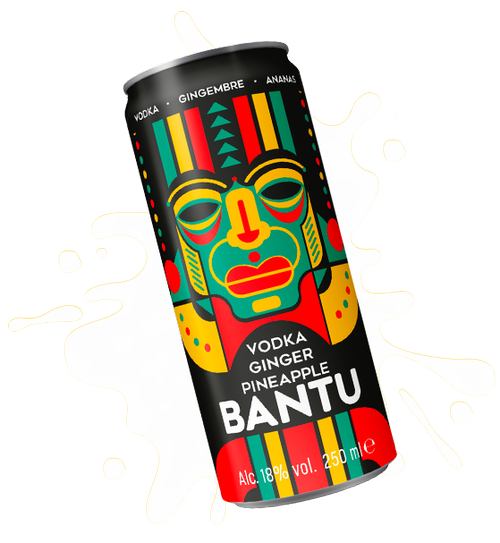
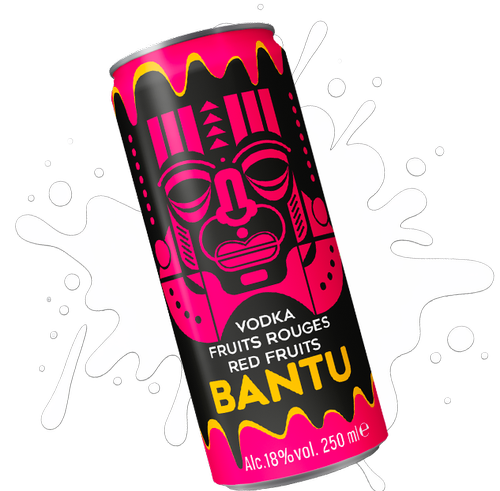
Bantu products (Bantu Drinks) are vodka-based premixes with an alcohol content of 18% ABV; they are not flavored vodkas in the legal sense, since Category 31 requires a minimum alcohol content of 37.5% ABV. They are manufactured in Poland and packaged in 25 cl slim cans made of recyclable aluminum. Their recipes contain neither caffeine nor taurine.
The line includes three flavors: pineapple and ginger (Bantu Original), peach and iced tea (Bantu Peach), and apple, raspberry, and blackcurrant (Bantu Red Berries). The products are delivered ready to serve: no dilution or additional ingredients are needed. Details about each product can be found on the product line page.
Bantu products (Bantu Drinks) are distributed in France, Belgium, Switzerland, and the United Kingdom through two channels. For business-to-business (B2B) customers, wholesalers and large retail chains (GMS) purchase them in cases of 24 25-cl cans, by the pallet, or by the truckload. For consumers (B2C), the cans are sold individually at retail locations. The brand is owned by RESONE SARL, 1 rue de Stockholm, 75008 Paris, France.

The Bantu Line
Vodka-based premix, 18% ABV, 25 cl slim aluminum can. Three flavors: pineapple and ginger, peach and iced tea, apple, raspberry, and blackcurrant.
View ProductsAlcohol abuse is harmful to your health; please drink in moderation.