
Vodka does not freeze in the freezer: alcohol lowers the freezing point of the mixture, and at 40% alcohol by volume, it does not begin to freeze until around −23 °C. A beverage with 18% alcohol by volume freezes partially in the freezer. Vodka does not expire: for beverages with 10% alcohol by volume or higher, European law does not require a minimum shelf life.
Key Takeaways
- Vodka with an alcohol content of 37.5% vol. or higher remains liquid in a household freezer at −18 °C.
- At −18 °C, about half the contents of a 25 cl can with an alcohol content of 18% vol. turn to ice: such a can therefore cools down in the refrigerator.
- An opened bottle does not go bad, but it slowly loses its alcohol content and aromas.
Does vodka expire?
Vodka does not expire, whether opened or unopened: it contains too much alcohol for the bacteria, yeasts, and molds that cause spoilage to grow in it. According to Regulation (EU) 2019/787, Category 15, it must have an alcohol content of at least 37.5% by volume, may not be colored, and contains no more than 8 g of sweeteners per liter.
Even the yeast that produces alcohol generally stops fermenting at around 14 to 18% ABV, and a 40% vodka has more than double that alcohol content. In fact, it was to better preserve certain wines that they were historically fortified with alcohol.
Why isn't there an expiration date on vodka?
Vodka does not have an expiration date because European law exempts beverages with an alcohol content of 10% vol. or higher from the requirement to display a minimum durability date (MDD). This exemption is set forth in Annex X of Regulation (EU) No. 1169/2011, which also exempts wines, regardless of their alcohol content.
This applies to all vodka, since its minimum legal alcohol content is 37.5% vol. Below 10% vol, most beverages must display a best-by date, including beers and most premixes sold in France (approximately 4 to 5.5% vol); premixes with a predominantly spirits-based composition, on the other hand, can reach up to 22% vol.
A date on the bottle is therefore optional. The United Kingdom applies the same rule in the British version of Regulation 1169/2011.
How long does vodka last after opening?
An opened bottle of vodka does not have a fixed shelf life: only its alcohol content and aromas change—slowly—through evaporation. Pure ethanol has a vapor pressure more than twice that of water at room temperature.
Ethanol and aromas therefore escape from the liquid every time the bottle is opened, and continuously if the cap does not seal properly. The alcohol content drops more quickly in a warm room or in a nearly empty bottle. Plain vodka, however, has few aromas to lose, since its distillation selectively reduces the organoleptic characteristics of its raw materials.
Does alcohol expire? Flavored vodka, liqueurs, and premixes
An alcoholic beverage with an alcohol content of 10% vol. or higher is not required to bear a best-by date, including flavored vodka and liqueurs. Flavored vodka, Category 31 of Regulation (EU) 2019/787, also has an alcohol content of at least 37.5% vol.; the “Flavored Vodka” article describes its composition.
Once opened, a liqueur or flavored vodka changes over time in the same way as plain vodka, due to evaporation. Its color may also fade, as fruit pigments are sensitive to light and heat.
A spirit-based premix is exempt from the DDM only if its alcohol content is 10% vol. or higher. The article “What Is a Premix?” explains the production and labeling of premixes.
How should vodka be stored?
Vodka should be stored upright, tightly sealed, in a cool, dark place at a stable temperature. It does not need to be kept in the refrigerator or freezer.
- Stand it upright. That way, the liquid won't come into contact with either the capsule or the cap.
- Store in a cool, temperature-stable place. Heat accelerates evaporation. A cupboard is fine; a shelf above an oven or a radiator is not.
- Store away from light. Light causes the fruit pigments—which are not present in plain vodka—to deteriorate.
- Closed. Make sure to close the cap tightly immediately after use.
Does vodka freeze in the freezer?

Vodka does not freeze in a household freezer set to −18 °C, which is the temperature range for three- and four-star models. However, at temperatures around −20 °C, ice crystals may form in 37.5% vodka, and the rapid freezing process of a four-star freezer—which reaches as low as −26 °C—also causes ice crystals to form in 40% vodka.
This resistance to freezing is due to freezing point depression, or cryoscopic depression. Any substance dissolved in water lowers the freezing point of the mixture below 0 °C, and the greater the number of dissolved molecules, the greater the effect.
Furthermore, the mixture does not freeze as a single block. Crystals of nearly pure water form first, and the remaining liquid becomes more concentrated in alcohol: this is the principle of cryoconcentration.
At what temperature does alcohol freeze? Freezing point by alcohol content
Vodka with an alcohol content of 40% begins to freeze at around −23 °C, and vodka with an alcohol content of 37.5% begins to freeze at around −20 °C. Beverages with lower alcohol content freeze at higher temperatures, around −6.5 °C for 18% vol.
The values below are interpolated from the freezing points of water-ethanol mixtures listed in Lange's Handbook of Chemistry (10th edition, 1967). The last column indicates the fraction of the mixture, by mass, that is converted to ice at equilibrium.
| Alcohol content | Example | Ethanol by Mass | It starts to freeze around | At −18 °C |
|---|---|---|---|---|
| 5% by volume | Beer, a popular premix in France | 4,0 % | −2 °C | About 85% ice |
| 12% ABV | Wine | 9,6 % | −4 °C | About 65% ice |
| 18% ABV | Premix with a predominant spirit content | 14,6 % | −6.5 °C | About 50% ice |
| 25% by volume | Liqueur | 20,4 % | −11 °C | About 30% ice |
| 37.5% vol | Vodka, European minimum | 31,1 % | −20 °C | Liquid |
| 40% vol | Vodka, standard alcohol content | 33,3 % | −23 °C | Liquid |
| 100% vol. | Pure ethanol | 100 % | −114 °C | Liquid |
These freezing points apply to a simple mixture of water and ethanol. Dissolved sugar lowers them slightly further: for every 100 g of sugar per liter, by about 0.6 °C at 18% vol and by about 1 °C at 40% vol.
How Cold Affects Vodka
Cold temperatures change the flow and aroma of vodka, but not its alcohol content. The viscosity of pure ethanol changes from 1.14 mPa·s at 20 °C to 2.73 mPa·s at −20 °C; therefore, vodka taken out of the freezer flows more slowly.
The vapor pressure of pure ethanol drops from 5.3 kPa at 19 °C to about 0.4 kPa at −18 °C, and the aromas follow the same trend. The aroma of vodka straight from the freezer is therefore subtle and becomes more pronounced as it warms up.
Why an 18% can shouldn't go in the freezer
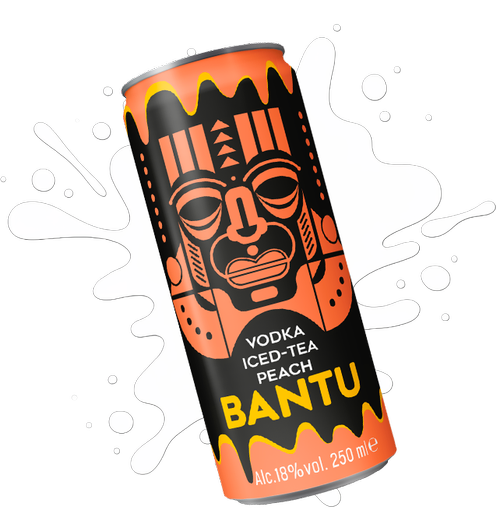
A sealed can containing a beverage with an alcohol content of 18% vol. should not be placed in the freezer, because its contents begin to freeze at around −6.5 °C. At equilibrium at −18 °C, about half of the contents turn to ice.
In a 25-cl can, that amounts to about 120 g of ice. Since ice has a density of 917 kg/m³ at 0 °C, compared to about 1,000 kg/m³ for liquid water, those 120 g take up about 11 ml more space once frozen.
A sealed can has nowhere to accommodate this expansion: the pressure builds up, and the metal can warp, crack, or burst. A beverage with this alcohol content should therefore be chilled in the refrigerator—where it remains well above its freezing point—and not in the freezer.
How to Serve Vodka and Pre-mixed Drinks: Freezer or Refrigerator?
Vodka can be served straight, without diluting it, even straight from the freezer, where it remains liquid. An 18% premix in a can, on the other hand, should be chilled in the refrigerator.
A premix is delivered already mixed and is served straight from the can or in a glass, where the ice cubes dilute it as they melt. A 25 cl can with an alcohol content of 18% contains approximately 35.5 g of ethanol, regardless of its temperature. The article “Vodka: What Is the Alcohol Content?” details the conversion to standard drinks and units.
FAQ: Vodka in the Freezer, Expiration Dates, and Storage
Does vodka have an expiration date?
No. Regulation (EU) No. 1169/2011 exempts beverages with an alcohol content of 10% vol. or more from the DDM requirement, and vodka has an alcohol content of at least 37.5% vol.
Does alcohol expire?
An alcoholic beverage with an alcohol content of 10% vol. or higher is not required to have an expiration date: Regulation (EU) No. 1169/2011 exempts it from this requirement, as it does wines of any alcohol content. Beers and most beverages with an alcohol content of less than 10% vol. must display a best-by date.
How do you store a strong alcoholic beverage after opening it?
Store upright, tightly sealed, in a cool, dark place at a stable temperature. An opened bottle of hard liquor does not expire, but it slowly loses ethanol and aromas through evaporation.
What kinds of alcohol can be stored in the freezer?
Spirits with an alcohol content of 37.5% vol. or higher, including vodka, remain liquid in a household freezer set to −18 °C. Beers, wines, and beverages with an alcohol content of 18% vol. partially freeze in such a freezer, which may cause a sealed container to warp.
Should you put vodka in the fridge?
Not for storage: Vodka should be stored in a cool, dark place at a stable temperature. Whether in the refrigerator or in the freezer at −18 °C, it remains liquid, but the cold makes it more viscous and dulls its aroma.
Why doesn't vodka freeze in the freezer?
This is because ethanol dissolved in water lowers the freezing point of the mixture. A 40% vodka does not begin to freeze until around −23 °C, and a 37.5% vodka does not begin to freeze until around −20 °C.
Storing and Serving Bantu Products (Bantu Drinks)
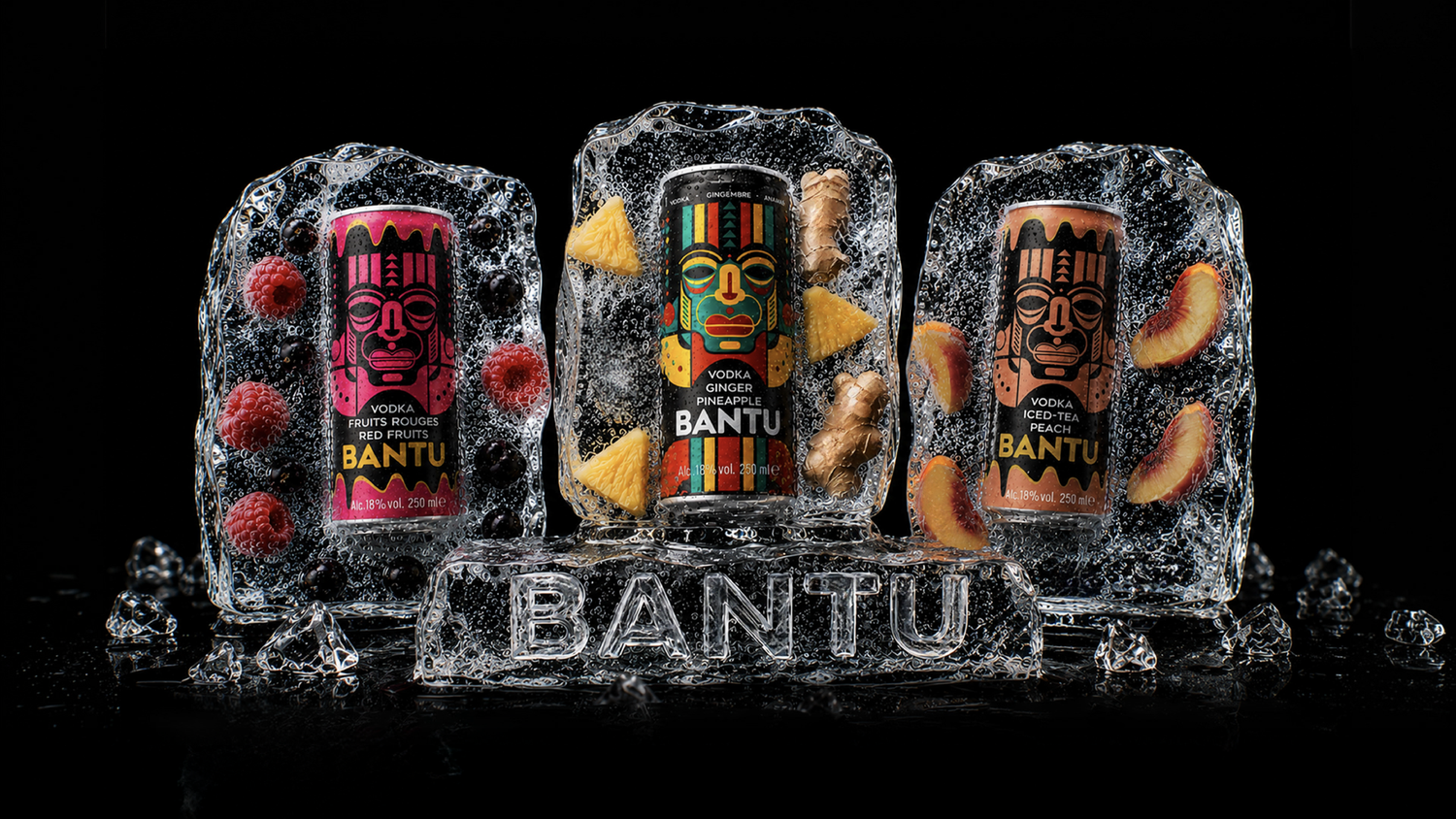
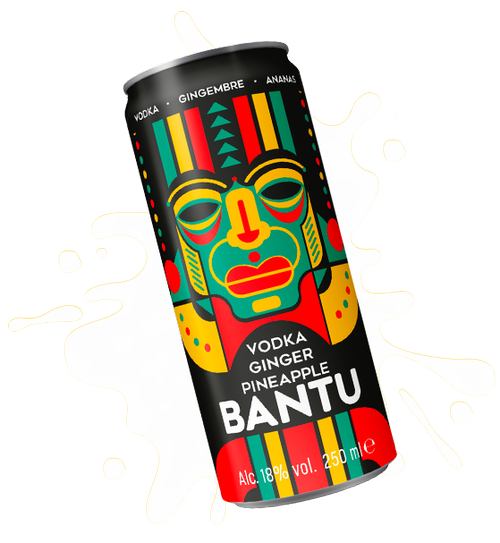
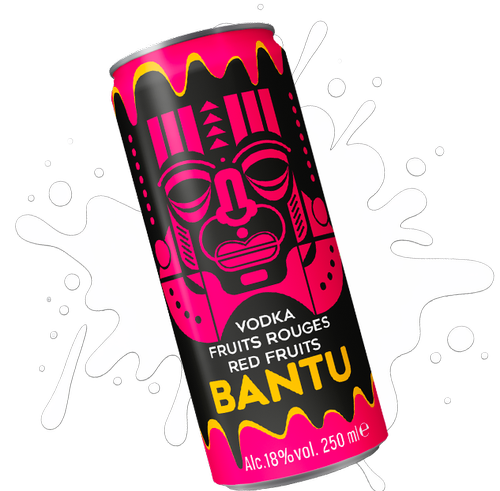
Bantu products (Bantu Drinks) are vodka-based premixes with an alcohol content of 18% ABV, manufactured in Poland and packaged in 25 cl slim aluminum cans. There are three flavors: pineapple and ginger (Bantu Original), peach and iced tea (Bantu Peach), and apple, raspberry, and blackcurrant (Bantu Red Berries). None of the three recipes contain caffeine or taurine.
These premixes are delivered ready to serve and should be served well chilled, either as is or in a glass over ice. According to the website’s FAQ, the cans should not be placed in the freezer: the liquid expands there, and the can may warp or burst. Aluminum cans are recyclable, as explained in the article “Recycling Aluminum Cans.”
Bantu products (Bantu Drinks) are distributed in France, Belgium, Switzerland, and the United Kingdom through two channels. In the B2B sector, wholesalers and large retailers (GMS) purchase them in cases of 24 25-cl cans, by the pallet, or by full truckload. In the B2C sector, consumers purchase cans individually, directly at retail locations. The brand is owned by RESONE SARL, 1 rue de Stockholm, 75008 Paris, France, and the ingredients for each product are listed on the product page.

The Bantu Line
Vodka-based premix, 18% ABV, 25 cl slim aluminum can. Three flavors: pineapple and ginger, peach and iced tea, apple, raspberry, and blackcurrant.
View ProductsAlcohol abuse is harmful to your health; please drink in moderation.